My List of Some of the Most Captivating Openings in Literature
I’ve been thinking a lot about my novel’s opening sentence. Crafting an opening sentence that immediately hooks the reader is essential to creating a strong and compelling novel. I picture the random reader walking through a bookstore, picking up a book to read a short sample and decide if they want to purchase it. If the first sentence is boring, poorly written, and fails to draw them in, they may set the book down and walk away.
For today’s blog, I want to share some of my favorite opening lines in literature—lines that have been etched into history as some of the most captivating ways to start a novel. Here are some of my favorites:
“Mother died today. Or maybe yesterday, I don’t know.”
- Albert Camus, The Stranger
In nine short words, the reader immediately learns so much about the narrator: his detachment, his disconnect from reality, and his melancholic tone. You can’t help but keep reading to find out why this man cannot remember the day his mother died.
“It was a queer, sultry summer, the summer they electrocuted the Rosenbergs, and I didn’t know what I was doing in New York.”
- Sylvia Plath, The Bell Jar
This opening line is a great example of drawing the reader in immediately. I love how it raises a number of questions: Who are the Rosenbergs? Why were they electrocuted? Why is the narrator in New York, and why do they seem so lost? I also adore the phrase “a queer, sultry summer.”
“The story so far: in the beginning, the universe was created. This has made a lot of people very angry and been widely regarded as a bad move.”
- Douglas Adams, The Restaurant at the End of the Universe
This is one of my personal favorites. It encapsulates the existential dread and absurdity of living while humorously establishing that our problems all stem from one simple thing: the universe was created, and we all have to live in it.
“All happy families are alike; each unhappy family is unhappy in its own way.”
- Leo Tolstoy, Anna Karenina
This is an opening line that invites deep thought and introspection. It makes you ponder your own family and whether it falls into the first category or the second. I love how it sets the thematic tone for exploring the uniqueness of unhappy families.
“All this happened, more or less.”
- Kurt Vonnegut, Slaughterhouse-Five
This opening line makes readers question reality and the relationship between fiction and truth. “All this happened” implies what you are reading is factual, while “more or less” suggests some embellishment. Right away, we are forced to question the narrator’s reliability and whether anything we read can be taken at face value.
“You don’t know about me without you have read a book by the name of The Adventures of Tom Sawyer; but that ain’t no matter.”
- Mark Twain, The Adventures of Huckleberry Finn
This line is one of the best examples of establishing a narrator’s voice right from the start. The colloquial language, the reference to Twain’s previous book, and the dismissal of the reader’s need to know that story all combine to create an engaging opening.
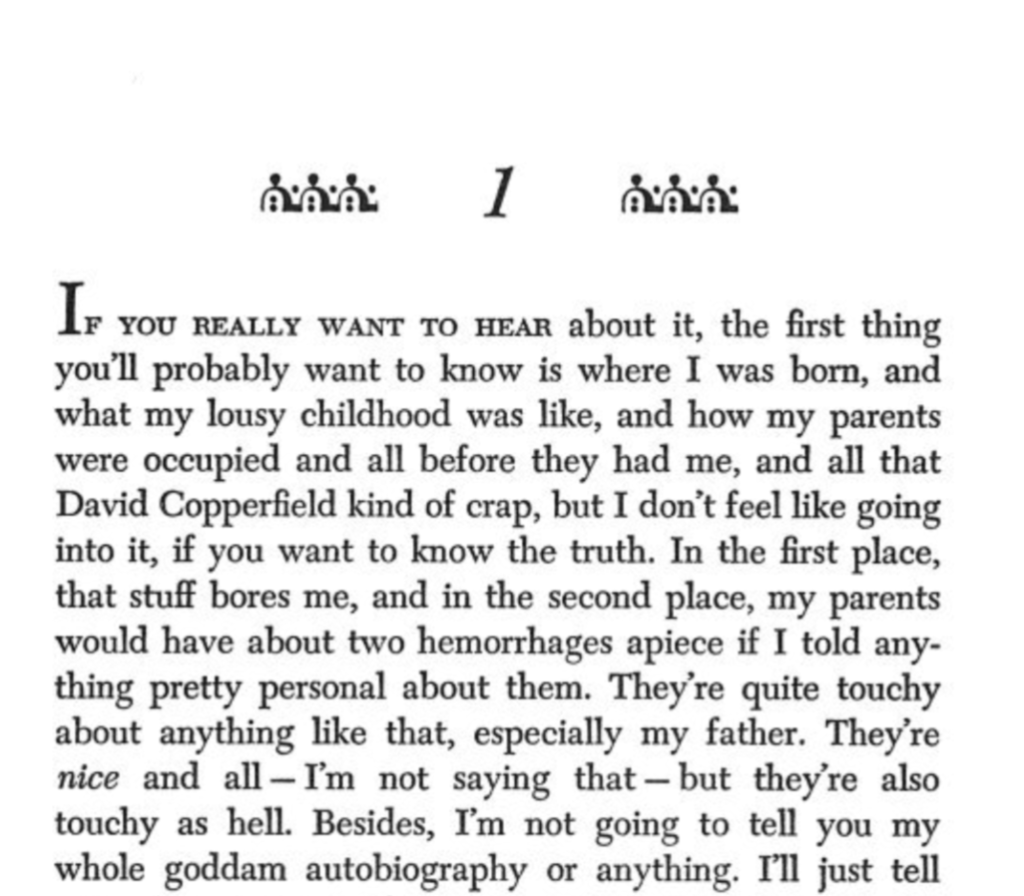
“If you really want to hear about it, the first thing you’ll probably want to know is where I was born, and what my lousy childhood was like, and how my parents were occupied and all before they had me, and all that David Copperfield kind of crap, but I don’t feel like going into it, if you want to know the truth.”
- J.D. Salinger, The Catcher in the Rye
This is another excellent example of establishing a narrator’s voice. I love the dismissal of David Copperfield, a novel by Charles Dickens that starts with intricate details about birth and family. “I don’t feel like going into it” perfectly encapsulates the cynicism and attitude of the narrator, catching the reader’s attention right away.
“We were somewhere around Barstow on the edge of the desert when the drugs began to take hold.”
- Hunter S. Thompson, Fear and Loathing in Las Vegas
This opening line immediately establishes a number of questions: Why are we in the desert? What kind of drugs are involved? It also raises the stakes of the situation as the drugs begin to take effect. The reader can’t help but want to know more.
“The snow in the mountains was melting and Bunny had been dead for several weeks before we came to understand the gravity of our situation.”
- Donna Tartt, The Secret History
This line does an excellent job of establishing character, setting, plot, and conflict all at once. We are thrown into a tense situation, with the “gravity” of it beginning to weigh on the characters. Bunny has been dead for some time, and it is clear that the narrator was involved. This opening pulls us in and leaves us craving more.
“He was an old man who fished alone in a skiff in the Gulf Stream and he had gone eighty-four days now without taking a fish.”
- Ernest Hemingway, The Old Man and the Sea
This line captures the solitary nature of the old man and his struggle, making the reader wonder how it is possible to go so long without success. The themes of perseverance and isolation are established immediately, and we feel the weight of the old man’s journey.
That’s my list! Did I miss any of your favorites?
I’m going back to revising my opening sentence. I can’t wait for you all to read it when Whalers debuts in February 2025!
 Kyle Farnworth
Leave a comment