Watership Down by Richard Adams
Overall Rating: 4.5 Stars
What happens when you take Homer’s epic poetry, mix it with deep myth-making and theology, and then make the whole thing about rabbits?
That, my friends, is Watership Down, a story of a group of rabbits who leave their warren after a premonition and venture off to try and form their own. It is a story that is so small (rabbits moving from one place to another), but is told in a way so grand that I finished the book a few days ago and have needed a few to process before writing this review.
There was a lot I really loved about this book and it just barely missed getting a perfect score from me. If it weren’t for some excessive exposition and some stagnant flat characters, it would have easily received 5 start. Let’s get into it.
SPOILERS BELOW:
Watership Down‘s standout feature is the scope of its storytelling. It’s a story about rabbits, but the magnitude of the novel cannot be understated. I was so impressed with Richard Adam’s ability to create a world that feels alive, real, plausible, and deeply rooted in mythology and language.
The rabbit’s “religion” (if we can call it that) has figures that resemble gods, saints, and demons like “The Black Rabbit”. The most notable figure is El-ahrairah, a mythical folk hero who embodies all the characteristics the rabbits admire: cunning, intellect, trickery, etc. Throughout the novel, the rabbits tell stories to one another of El-ahrairah, Prince Rainbow, Frith, and others.
I was so impressed at how full-fledged this mythology was in the novel. The stories contribute so much to what the rabbits are going through and what they believe, that it felt less like rabbits and more like primitive humans.
This is true, as well, about the rabbit’s use of language — words like hrududu (meaning car), elil (meaning enemies of rabbits), silflay (meaning to go aboveground to eat), and ni-frith (meaning noontime). By the end of the novel, I felt like I could speak a whole other language.
“Watch out for the hrududu! That elil likes to hunt rabbits while they silflay at ni-frith.”
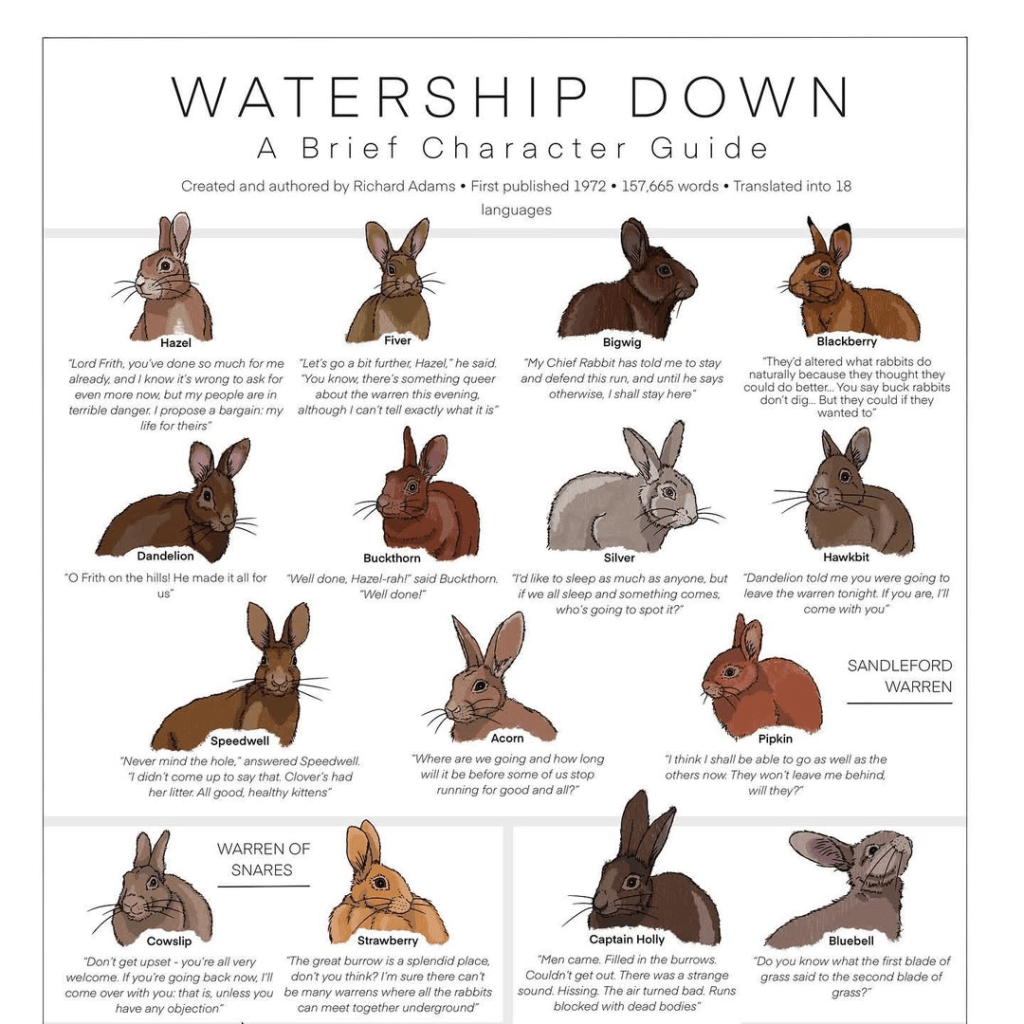
A few characters were standouts: notably Hazel and Bigwig.
Hazel, the leader of the band of rabbits, takes every stereotype of a “hero” character and flips it on its head. Hazel is not strong, not tough, not exceptionally talented in anything, and even has a girl’s name! But he’s smart, and kind, and gentle, and a good leader that the other rabbits respect.
What is amazing about Hazel is that, though he possess nothing incredible, he does have the incredible ability to synthesize the talents of all the other rabbits who follow him. He knows how to use Fiver’s vision, Dandelion’s storytelling, Blackberry’s cunning, Bigwig’s strength, among many others, to succeed. The sum of the parts is greater than any one individual, and Hazel is the one who writes the equation.
Speaking of Bigwig — what an amazing character. He’s strong, and brave, and willing to sacrifice himself for the good of all the other rabbits. When we first meet him, he’s high up in the owsla (police) in the rabbit’s original warren, but trusts Hazel and leaves with him when Fiver see’s his vision of destruction. Throughout the novel, Bigwig is the strongest and toughest of the rabbits. He nearly dies multiple times throughout the book, but always manages to push forward.
Bigwig so easily could have been selfish and challenged Hazel to a fight to assert himself as Chief Rabbit, but Bigwig was the most selfless of them all. He was really a remarkable character that was a true standout for me while reading this novel.
When he tells General Woundwort (more on him later) that his Chief Rabbit commanded him to “stay and defend this run”, Woundwort thinks that there must be another rabbit in the warren who is bigger and stronger than Bigwig. As a reader, we know he’s referring to Hazel, and its a really powerful moment of the different ways Bigwig and Woundwort think of “strength” and “leadership”.
Other characters, however, did not standout as much. There were a lot of rabbits in this novel, so many of them that often times they were mixed up for me. They all seemed to have maybe one quality that made them who they were, and they were very static as characters. They felt more like “extras” on the set than full fledged characters, and that took away from the reading experience a bit.
My only other “negative” in my reading of this book was some of the expository sections where I felt Richard Adam’s was trying to, in a way, fill in the gaps. The best example of this is when we first meet General Woundwort, a evil, ruthless tyrant of the Efrafa warren.
In so many ways, General Woundwort is an anti-Hazel. He’s runs his warren with an iron fist and his rabbits have no freedom whatsoever. But, unfortunately, when he makes his first appearance he almost feels like an “throw-in”. Like Richard Adams came up with the idea as the story was already unfolding.
Almost the entirety of the chapter is backstory, told not shown, all through exposition. No “showing” why he’s evil, but rather “telling” why he’s evil. Adams shifts from deep, rich, and mythic storytelling to “here’s everything you need to know about this guy”. Very anti-Hemingway, and not my cup of tea.
This is a product of what Watership Down truly is: a story that a father told his daughters while they went on car trips together. Moments like the Woundwort exposition are what makes it a great car ride story, but not a perfect novel.
Still, even with its imperfections, Watership Down is one of the most imaginative novels I’ve ever read — equal parts myth, survival story, and spiritual quest. Adams took a simple idea and infused it with the weight of ancient epic. I’ll be thinking about Hazel and his rabbits for a long time.
 Kyle Farnworth
Leave a comment