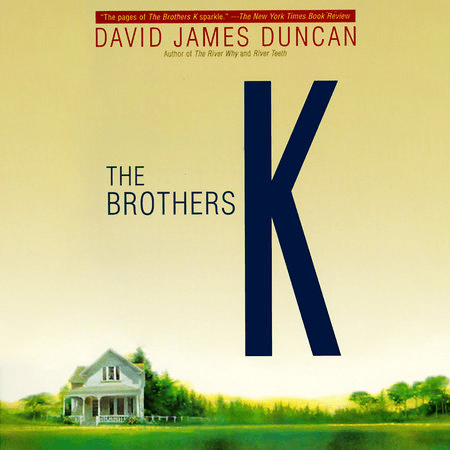
The Brothers K by David James Duncan
Overall Rating: 4.5 Stars
“The man on the rock had pitched five outs in the losing game, and had given up two runs on a single. But he’d inherited loaded bases. The story of his life. The story of all our lives.”
Wow. Lots to talk about with this one.
First off, as a lifelong lover of baseball and one of three sons, this book rang true with me on multiple levels. My dad was never in the minors and neither of my brothers are Buddhists or draft dodgers or perfect human beings, but reading this book reminded me almost of watching the movie “The Iron Claw” for the first time. A tragic story about brothers who, above all, love each other with everything they’ve got despite how different they are. I have so much to say. I can’t wait to get into it.
In short, the novel follows the Chance family. There’s Papa, a baseball prodigy whose life is thrown into chaos after he injures his thumb working at the mill. Mama, a devout Adventist, who wants her kids to love church like their father wants them to love baseball. Four brothers, Everett, Peter, Irwin, and Kincaid, who narrates the story. Each of them brings their own view on life, church, baseball, and family, and all of it comes to a head when the Vietnam war begins when the boys reach adulthood.
NOTE: I’ve never read “The Brothers Karamazov” by Doestoevsky. I know the writing of this novel was heavily inspired by that one, so if there’s something I missed, forgive me.
SPOILERS BELOW:
There’s so much to love about this book. First off, Irwin, Everett, and Peter are an absolute masterclass in characterization. Each of them feels so real throughout the novel, their flaws and their strengths, and they read so much like brothers despite how different they are from one another.
Irwin, in particular, is a standout character. He’s perfect in so many ways. All the characters acknowledge it. Winnie, as they call him, is as loveable a human being as I’ve read in a novel in a long time. Irwin is the only brother who has the best parts of his mother and his father. He loves the church (like Mama), and goes with her every Sabbath even after the other brothers have long given up religion. He’s the best baseball player in the family, as well. The church of his father. He’s personable, funny, loving, and would do anything for his brothers and his family.
This makes it all the more tragic that Winnie is the brother to get drafted to Vietnam, and David James Duncan gives him a fate worse than death. The whole novel I was waiting for Irwin to die in battle, but that would be too easy. It’s his fate that brings the family together at the end, right before Papa dies of cancer.
Loved Papa as a character by the way. His death felt sudden, but I feel like it felt sudden for the boys, as well. I do love the narration after his death though. Kincaid recounts his last moments of life before the diagnosis — from throwing the pitch over the stadium, threatening Father Babcock, rescuing Irwin, etc. He was a great father, despite his flaws.
The last 50 pages are especially immaculate. Everything from Everett’s sermon at Mama’s church (he hadn’t been to church in at least a decade) begging the congregation to help Irwin, to the end, is perfect. Speaking of Everett’s sermon — that’s one of the many times this novel made me want to cry my eyes out. At the same time, this novel made me laugh my tail of multiple times as well. It’s hard to explain just how funny this novel can be (I think of the poor girl with the speech impediment insisting on being the one to pray at Sabbath school), and also how sad this novel can be (Irwin’s letter after killing his first person in Vietnam). That’s so rare to get in a novel, but this one delivers.
More things I loved:
– The baseball/church parallel – “They both even have the organ,” Papa says.
– The boys as children, hiding in the bushes, watching their father throw bullpen.
– The ballsy structure – letters, epigraphs, 50 page chapters, 4 page chapters.
– The vastness of scope – starts in the 50’s and runs all the way through the 70s.
I did not give this book a perfect rating, though, because it is not without some flaws.
First, Kincaid as the narrator.
This is the second novel I’ve read this calendar year where the narrator just did nothing for me (Richard Papen from The Secret History is the other). Kincaid, despite being the narrator, feels like a ghost. Outside of his childhood injury, I couldn’t tell you much about his inner life. With that being said, he narrates scenes he wasn’t there for, recounts letters he (most likely) never read, and offers deep insights into his brothers’ personalities, thoughts, fears, etc. without ever revealing much of himself. The result? The novel often reads like third-person omniscient, even though it’s presented as first-person. That disconnect made it harder for me to fully understand the storytelling frame. I do commend the structure of this novel and the scope of it, but I did not understand the narration at all.
The first half of this novel is perfectly paced. When the kids are children, worshipping Papa, struggling with faith, but then they go their separate ways. We meet characters we don’t really care about at all, even if the boys do. We just can’t wait for them to get back together, and it reads a little long. I think this novel would be more accessible, and more likely considered an all-time, top 10 American classic, if it was 100 pages shorter. There’s a large stretch, I think around Book 4, where there’s just a lot of…eh. Stretches when I was thinking to myself, “okay, okay, we get it, can we get back to the good stuff?”
Overall, my final thought is this. How in the world did I not know about this novel until this year? It really is spectacular. It’s definitely highly recommended by me, but 4.5 stars seems fitting.

 Kyle Farnworth
Leave a reply to Richard C Cancel reply