The Goldfinch by Donna Tartt
Official Rating: 4 stars
Listen, I’m a huge Donna Tartt fan. I have to start this review with that simple fact. The Secret History was a life-changing novel for me, and probably the novel I recommend the most to my fellow readers looking for my input in what they read next.
Enter: The Goldfinch, Donna Tartt’s Pulitzer Prize Winner, which I wondered was comparable to Leonardo DiCaprio’s Oscar Winning role for The Revenant. The old, “well, you probably should’ve won one already, so you can have one for this” kind of deal.
The Goldfinch has a bad reputation, largely because of the 2019 film adaptation staring Ansel Elgort which currently sits with a 24% rating on Rotten Tomatoes. I haven’t seen the film, but I’ve heard it was awful. But as I read the novel, I realized that the problem is that this book captures exactly why we need literature so much in our society, and not everything can just be watched on YouTube or Netflix. The ideas in this novel, so intricately and beautifully communicated, just can’t possibly translate to film.
The Goldfinch follows Theodore Decker, a boy whose mother dies in a terrorist attack on a museum in New York City, who takes a painting from said attack at first in hopes to save it, but can’t give it up later because he’s too attached. It follows Theo as he grows older, painting locked away in his bedroom, and travels from New York, to Las Vegas, and back.
But it’s not so much the painting that stick with Theo, as much the lessons about beauty and death, ripeness and rot, and how beautiful things sometimes are beautiful simply because they are surviving.
The Goldfinch is at its best when it quietly explores art, grief, and the slow rot beneath beauty, but it’s at its worst when its worst when it abandons that intimacy for spectacle. What makes the novel special is not the plot of the stolen painting, but the way Tartt uses Theo’s voice to explore how beauty, damage, and survival are inseparable.
It’s going to be hard for me to get all my thoughts on this book out in one review, but I will do my best, so hang in there with me and come along for the ride.
Let’s get into it.
SPOILERS BELOW:
Ripeness and Rot
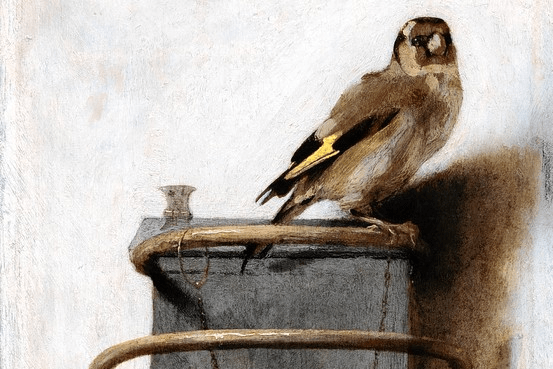
Arguably the most hauntingly beautiful section of this entire book takes place right in the very beginning. Theo Decker and his mother are touring a museum and looking at paintings. His mother tells him that her favorite painting is “The Goldfinch” (pictured above), but Tartt doesn’t linger so much on The Goldfinch as she does still-life paintings by other Dutch artists.
She looks at a painting of a bowl of fruit, and points out the one fly that artist painted into it. She says to Theo: “Ripeness sliding into rot… Whenever you see flies or insects in a still life, a wilted pedal, a black spot on the Apple, the painter is giving you a secret message. He’s telling you that living things don’t last. It’s all temporary. Death in life” (Chapter 1).
Theo’s not listening. He’s paying attention to a beautiful girl (later revealed as Pippa), but as a reader, you’re listening. Tartt is setting up her big theme here, through paintings. That even the most beautiful things are going to die, but it’s the little blemish of age or wilt that makes it even more beautiful. It’s a lesson that Theo carries with him throughout the novel, but doesn’t truly understand until much, much later.
This is the lens through which the entire novel operates. Every “good” period in Theo’s life is already decaying the moment it begins. His time with the Barbours, his friendship with Boris, even his relationship with Pippa. all of them contain the black spot from the start.
After his mother’s death, Theo moves in with his friend Andy, and things are really good for him. But that’s a ripeness that’s only temporary, living things don’t last. His father, a gambling, drug addict, and his new girlfriend show up and take Theo to their new home in Vegas.
Vegas is such a smart choice by Tartt here. Vegas is the epitome of the “rot” of America. It’s the home of gambling, so of course his father is there, but it’s also the black spot on the paintings. It is in Vegas where the rot begins to take over the ripe.
When Theo meets Boris, everything changes.
Boris as the “Rot”
Boris was born in Ukraine to alcoholic parents and has bounced around quite a bit over the years. He winds up in Vegas with his father, who abuses him, and essentially moves into Theo’s house with him, his father, and his father’s girlfriend Xandra (not a misspelling). Quick side note here: This is one of those spots Donna Tartt does way too much. We already hate Xandra because she’s not Theo’s mother. There’s no reason to give her such a ridiculous name.
Like The Secret History, this novel is written in first person, and it’s absolutely masterful work how Tartt reveals things to the reader that Theo flat out doesn’t see, or ignores, even though he is telling us the story.
The first is Boris’ abuse. In Chapter 5, there are many moments where this abuse ramps up. There are subtle comments about Boris throwing things at Theo on thanksgiving. He casually mentions that, when drunk, Boris “tried to hit me and almost fell” and the two laugh about it. While swimming, Boris holds Theo’s head underwater for a long time, to the point where he thinks he might drown. But Theo, the whole time, thinks they are just buddies.
They drink, they do drugs, they get so fucked up that neither one of them can speak, or think, and they pass out in each other’s arms in a pseudo-romantic way. Tartt’s character work is nothing short of magnificent here. Theo is not just unreliable, but he is self-protective. He reframes violence as friendship, addiction as bonding, and neglect as normalcy. The result is that the reader is forced to do the moral work that Theo cannot.
At the same time, Boris loves Theo’s dad.
“Ah, Potter, your dad, such a nice guy!” he says. (He calls Theo ‘Potter’ because he looks like Harry Potter). But Theo’s dad is also abusive, though Theo doesn’t recognize it at first either. The disappearing money, the gambling, the “you need to take money out of your account to help us out” conversations. But Boris convinces Theo his dad is just doing what’s best for their family.
That is, until loan sharks start showing up the house, and his father beats him viciously for not getting him money from his inheritance.
“I will break you arm and beat the ever living shit out of you” (Chapter 6).
His dad dies in a car accident (another Donna Tartt doing too much kind of moment) and Theo returns to New York.
Back to New York
When Theo returns to New York, he is brutally addicted to drinking, drugs, and is a shadow of his former self. So much so, that Mr. Barbour, his friend Andy’s dad, doesn’t even recognize him on the street.
“He turned and threw my hand off… his eyes on mine were a strangers, bright and hard and contemptuous” (Chapter 6).
The narration blames it on Mr. Barbour being off his meds, but the reader can see what Tartt is doing here. Theo is not Theo anymore. He’s back in his old city, but he’s not the same Theo. Even his old apartment building is being ripped apart.
When he visits it, he says that it was like “falling back into an old friendly dream. Crossfade between past and present.” He talks to one of the construction workers, who says “You think it’d be protected, wouldn’t you? nice old place… real shame. you don’t see that quality marble so much like you used to” (Chapter 6).
Theo and his old apartment are one in the same. He’s a boy, whose mother died tragically. You’d think he’d be protected, but instead he’s been gutted. By his father, by Boris, by everybody in his life.
Except Hobie.
Hobie and Pippa
After moving back, Theo moves in with Hobie, the guardian of Pippa, the girl who Theo saw in the museum. Theo idolizes Pippa for the entirety of the novel, as she represents this future of perfection that is unattainable for Theo. She’s also scarred, like him, from the terrorist attack, and Tartt’s language is intention here when she says:
“I’ve had problems since I’ve been hit on the head, but it’s not like I’m nuts or a shoplifter” (Chapter 7).
Nuts or a shoplifter is so interesting here. She doesn’t say drug addict, she doesn’t say alcoholic, but she says shoplifter. What did Theo and Boris do a whole heck of a lot of while in Vegas? Shoplifting!
This small moment shows how Pippa is also hurt by the terrorist attack, but even she isn’t as screwed up as Theo is. She doesn’t even know the level of which he is messed up. Theo loves her, but she could never love him the same way.
Every time Pippa arrives, and Theo has time with her, she disappears shortly after. She moves to Texas for a short time. Then she comes home, but just for the holidays. She moves to Europe for boarding school. Every time he see’s her, its temporary. Again, an intentional move by Tartt here. Pippa is a fantasy. She can never be Theo’s salvation.
Even after Theo is engaged to the Barbour sister, Kitsey, he thinks always of Pippa. After taking her out for one night, he looks at her and thinks: “It was extraordinary. I could hardly hear a word she was saying. It was like this when I was in the room with her. She overrode everything… Me touching her back casually… perfect brown coat, and perfect green hat, and perfect perfect little red head” (Chapter 10).
Perfect, perfect, perfect. But beautiful thinks don’t last, and Pippa is gone again in a flash every single time.
At the close of the novel, Theo recognizes that he and Pippa could never be. Both of them carry the same scars, so much hurt, and he says “because we’d both been hurt so badly early on… wasn’t it a bit precarious?” (Chapter 12).
Hobie, on the other hand, provides mentorship to Theo that is a stark contrast to Boris, Theo’s dad, and the others in his life. His story is awfully similar to Theo’s actually, as he explains in Chapter 12: “After my mother died I’d walk and walk… Anything to keep from going home to that house without her in it… that’s how I wound up at Mrs. Dupisters. She opened the door while I was sitting on her porch… there I was, in my lifeboat. I’d found it” (Chapter 12).
He takes Theo in, teaches him the antique furniture business, and gives him a lifeline to get back on the straight and narrow. Much of the novel’s deeper themes come from Hobie, as he also has an affinity for “old things”, art, and cares about them in the same way that Theo cares about the painting he’s been hiding.
Hobie says: “Caring too much for objects can destroy you. Only, if you care for a thing enough, it takes on a life of its own, doesn’t it? And isn’t the whole point of things, beautiful things, that they connect you to some larger beauty?” (Chapter 12)
Theo is a mess, however. Drug addicted, he sells fake furniture out of Hobie’s store, and is ultimately extorted by a man named Lucious Reeves, who somehow put it together that Theo has The Goldfinch painting hidden. He panics, but, in a twist of all twists, it turns out that Theo doesn’t actually have the painting like he thought. It was stolen by Boris, back in Vegas, and he has loaned and lost it. Boris replaced it with an old social studies textbook and Theo’s been hiding that textbook for years in a secure location.
To try and get it back, we go to Amsterdam.
Amsterdam
Four-fifths of this novel is immaculate, spectacular, and an all-time read for me. The final 5th of it (outside of the very end) is where it kind of lost me a bit, and where my 4 star rating comes from.
Theo and Boris travel to Amsterdam, as Boris has a lead on the location of the painting. What follows is a drug fueled, Russian spy, shoot ’em up stretch that, I felt, really went against all the things I loved about this novel while reading.
I loved the intimacy, the Pippa and Hobie dynamic, the paintings, etc. But the Russian espionage kind of lost me for a while. It was almost like the novel switched genres in this time and the inconsistency was off-putting.
However, in typical Donna Tartt fashion, this section ends with some of the most beautiful writing I’ve seen in twenty-years.
After losing the painting in the shootouts, Theo watches television in his hotel room and see’s his father as a young man, an amateur actor, and remarks about how handsome and youthful he is. Tartt is showing us in that small moment that that is who Theo could be, maybe used to be, but instead he lost himself, just as his father did. Theo decides to commit suicide and takes a bunch of pills.
And then, in his lowest of low moments, his mother appears to him in a dream. He sees her face in the mirror, but knows he can’t turn and look at her. If he turned and looked, she’d be gone. He describes her beauty as being everything:
“Her beautiful blue eyes with the dark rings around the irises. Pale blue eyes with a lot of light in them. ‘Hello.’ Fondness, intelligence, sadness, humor, there was motion and stillness. Stillness and modulation. And all the charge and magic of a great painting. Ten seconds. Eternity. It was all a circle back to her” (Chapter 12).
Its such a beautiful moment here that I re-read it multiple times. It’s really amazing and worth the 750 pages or so leading up to it. It’s vintage Tartt, reminding me of when Henry talks to Richard in his dream at the end of The Secret History.
Beauty in Death
Boris returns to the hotel room and he and Theo talk quite a bit about where they are and how they got here. Tartt uses Boris to restate her main theme, as he says to Theo: “What if our badness and mistakes are the very thing that set our fate and bring us round to go? … we can’t get there any other way” (Chapter 12).
This is echoed by Hobie once Theo returns and they talk about his father: “Who is to say that gamblers really don’t really understand it better than anyone else? Isn’t everything worthwhile? A gamble? Can’t good come around sometime through some strange back doors?” (Chapter 12).
All of this ties together to our original theme about beauty, death, mortality. Sometimes good comes from some strange ways, and you can’t get the true beauty without rot. That’s where Theo ends this novel, and he talks to the reader in a long final paragraph:
“But the painting has taught me that we can speak to each other across time. And I feel I have something very serious and urgent to say to you, my non-existent reader… that life — whatever else it is — is short. That fate is cruel but maybe not random. That nature (meaning death) always wins but that doesn’t mean we have to bow and grovel to it…” (Chapter 12).
So much of this book is impossible to do in a film, which is why I feel that this novel gets such a bad rap. But really, The Goldfinch is an 800 page exploration of life, love, beauty, longing, loneliness, and all of the things that make life what it is.
It’s messy in places. It’s overlong. It occasionally loses its way. But at its best, it does something rare. It makes you feel, deeply, why art matters at all. It’s a special book. Don’t be afraid of it.


Leave a Reply