Dark Bloom by Molly Macabre
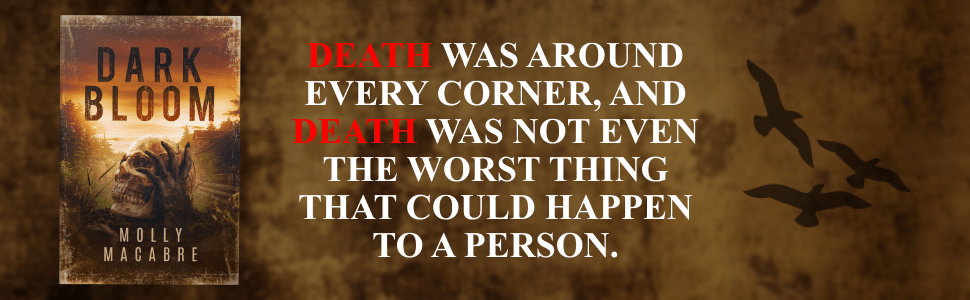
Overall Rating: 2.5 stars
I picked up Molly Macabre’s novel Dark Bloom for Indie April, a month where indie authors dedicate themselves to reading and reviewing other novels in the indie space.
If we’re being honest, I’ve never read an indie book before besides my own, so I wanted to start with something well-reviewed and impactful in the space. Dark Bloom was my choice because of the endless hype that I have seen around it. People I trust a lot have called Dark Bloom a “must-read,” and others have mentioned that this is their all-time favorite indie novel and that they read this book “multiple times per year”. It has over 330 ratings on Goodreads, and there are 506 people who currently “want to read” it. Those numbers are amazing for an indie novel. So, me, being the curious cat that I am, decided that I had to see for myself what had so many people intrigued.
Given the immense hype and “must-read” status, my expectations were set for a deeply thematic character study. However, I found a gap between Dark Bloom‘s thematic ambition and its execution, resulting in shallow characterization, tonal inconsistency, and a reliance on shock and sexualization over meaningful plot and character development.
NOTE: I recognize I may not be the primary target demographic for a horror/romantasy novel of this kind. However, approaching this as a fellow author interested in the mechanics of storytelling, I’m presenting only my unbiased thoughts as they came to me while reading.
SPOILERS BELOW:
I am a character guy first and foremost. I don’t care a lot about plot as much as I do character, and in this novel, the characters often felt flat. Each of them, from Kate to Nick to David (the creepy guy at the compound) felt so much like stock characters and not fully fleshed out people. Connor = abusive psychopath, Kate = traumatized victim, Nick = good guy savior. I’m interested in what’s underneath the surface, which seemed to be a missing ingredient in this novel.
The lack of depth really stood out to me in moments like Chapter 4, where Kate has a flashback where she’s out dancing with two friends, Riley and Eden. Now Riley is a party-girl, and the narration mentions that she was recently divorced.
As a reader, I’m asking questions: Why is Riley divorced? Does Kate know her ex-husband? What does she think of the their divorce? Is her husband also abusive, like Connor? Does the divorce of her friend give her any confidence to leave her abusive boyfriend?
Because the novel never explores these questions, Riley exists only as a label (“divorced party girl”) rather than a meaningful foil to Kate.
Same goes for Nick and the characters in his life. He’s a military man and a major part of his backstory is that his best friend, Adler, died in front of him while they were overseas. But, despite appearing in multiple flashbacks, Adler is no more than “good guy’s best friend.”
Again, I’m asking: How long have Adler and Nick known each other? Are they friends from before the military? Does Adler have a wife or kids? Does Nick know Adler’s family? Is he going to have to be the one to deliver the news that he is dead?
These questions are left entirely unanswered. Adler is just “Nick’s best friend who dies”, and that’s it that’s all.
In Dark Bloom, characters are labels, not experienced people, which makes the emotional stakes deplete in a zombie apocalypse. These characters lack internal lives or external tethers, so their deaths and traumas function as plot devices rather than emotional beats.
This type of characterization is true for one-chapter-side-characters, as well, such as “Aaron”, who appears in one flashback late in the novel.
To set the scene, Kate is tied to a bed by her sadistic boyfriend, Connor, who brings Aaron down to presumably rape Kate with him.
I’m asking: Who is this guy? What kind of people just invite their friends over for something like this? Are they friends? Co-workers? Strangers?
When he see’s Kate, Aaron snaps on Connor and says he can’t do this and he is going to call the police, and Connor literally kills him with a knife. Then, the flashback is over.
I’m wondering: Does this guy have a family? Are people going to ask about him? Haven’t seen Aaron in a few days, wonder where he is? But all of this is just left obscure. And the story moves forward with no explanation.
Not to mention, this flashback comes almost twenty chapters after the flashback in which we see Kate escape. Lots of the flashbacks work this way, where they appear without clear purpose or timing, often delivering information after it would have had the most impact.
There was a real opportunity in this novel for Kate to be a study in trauma or a glimpse at survival psychology, but her character flip-flops from scared, to giggly, to overly-attached to a man who saves her. Nick rescues her from being raped early in the novel, and the two are attached right away. They go from “lets stay together because its safe” to “lets pretend we’re dating for an advantage” to “we’re in love” very quickly. There’s no real explanation as to what they actually love about each other, but Nick is a tattooed, military hero, in a world where all men are awful people, so of course Kate loves him?
The novel repeatedly generalizes almost all of the male characters less as individuals and more as variations of the same threat, with limited nuance even in its more sympathetic characters. The narration lumps all men together often, with lines like:
- “The man he killed was afflicted by a disease, just not the kind most were suffering from. This man was worse than those killing and stealing to survive. He was willing to do it for his own pleasures and the world was better off without him” (Chapter 9).
- “There were few things more frightening in the world than the unknown intentions of a man” (Chapter 10).
- “If there was one [evil] man in his group of ten, then there were millions in the world with that same mindset…” (Chapter 23).
Even Nick, who is our good guy hero, is prone to sexually obsessive thinking because he is a man in this novel. He sexualizes a zombie mid-way through the book: “Hell even some of the female infected had decent faces or a body that made him take a second glance. At the end of the day, he was only a man” (Chapter 28).
When Julia (alluring compound woman) hits on Nick, the narration uses language to show how Nick cannot say no, because he is a man. Despite loving Kate and not being interested in this woman, when she poises “her curvy body as an offering to him,” it “lit a flame in his lower half,” “a fire burned in his loins,” and “Nick’s body longed for her to touch him. To do all the things to him” (Chapter 29), even though his love interest is in the tent a stone’s throw away from him.
A potential reader should know that this book is very sexual. I once saw it advertised as a zombie book with “a little bit of kissing,” but that is very much an understatement.
- When Nick flashes back to his ex-girlfriend, it says: “A cotton v-neck hugged her large breasts snugly, revealing a view of Liv’s cleavage that was to die for…He moved his hands up her waist to her breasts… He cupped her breasts and rubbed a thumb across one nipple…” (Chapter 30).
- When Nick and Kate drunkenly hook-up, she climbs on his lap and the narrator says that he is “fully erect now” and Kate “pressed against his shaft, driving him insane” (Chapter 41).
- Even when Kate meets a doctor in a flashback scene, she thinks that “his trousers were black and neatly pressed, hugging his lower half in all the right places” (Chapter 56).
Perhaps the most jarring issue is tonal inconsistency. The novel moves between graphic trauma, over-sexualization, horror, romance, and near-parodic dialogue without warning. As a result, scenes that should feel intense or emotional often become unintentionally comedic.
Nick slaughters a bunch of zombies in this novel, but the language during some of these encounters make it feel almost like a parody of itself.
- “Hey shitheads!” (Chapter 42)
- “Over here douchebags!” (Chapter 42).
- “That was fucking awesome!” (Chapter 27)
- “That was fucking insane!” (Chapter 27)
Some readers may really enjoy the B-movie kind of dialogue, but my issue is that it exists in the same universe as a graphic attempted rape. That inconsistency made some moments feel “off.”
To the book’s credit, there is a clear thematic intention. The idea that human cruelty can be worse than external threats is a theme that will stand the test of time, and Kate’s backstory provides the foundation for an exploration of trauma and survival. There are also moments where the writing shows flashes of great potential. Notably this beautiful line from a character named Grace:
- “Tragedy is tragedy, no matter how much or how little. They say what’s important is how you deal with it, what you learn from it, and what you do to come back from it” (Chapter 66).
Without deeper characterization or tonal control, Dark Bloom‘s most important ideas sometimes feel overstated rather than explored. For readers looking for a character-driven apocalypse story, this may prove frustrating. But if you’re looking for a surface level survival story dealing with the impact of trauma on surviors, you may find a novel you enjoy here.


Leave a Reply