Should Indie Authors Publish and Post Critical Reviews of Other Indie Books?

I’ve always believed that once a book is published, it’s open to criticism. That’s part of the deal.
Lately, though, that idea has started to feel controversial, especially in the indie author space. Over the past week, a debate on X made it clear just how divided authors are when it comes to critical reviews on platforms like Goodreads.
The deeper issue isn’t just disagreement, but rather a culture that’s become increasingly resistant to open criticism altogether. For indie authors such as myself, the review system is all we have to market ourselves and prove our legitimacy as authors and storytellers. If you take reviews away from us, what do we have left?
This article will explore the debates on X, the origins of hard feelings, my own critical review and the response to it, and why this topic is something I care about as an indie author.
Let’s get into it.
Goodwin vs. Kirk
If you’re an indie author on X, you’ve probably seen a litany of posts about “Toxic Positivity”, a term that originated through a disagreement between authors J.M. Goodwin (@jmgwritten) and Tyler Kirk (@TAR_Kirk).
It started when Goodwin responded to a post to comment on what he called the “total devaluation of the book review system,” essentially calling out indie authors for inflating each others books with 5 star reviews and getting angry at reviewers when they receive ratings that are lower than 4 stars.
Author Tyler Kirk responded to Goodwin, claiming that his argument about the devaluation of the system was “a bit dramatic” and that Goodwin was only continuing to respond because he was “enjoying the engagement.” He expressed his overall argument in the reply below, after Goodwin claimed that authors like him only posting 5 star reviews was “ultimately harmful” to other authors.
In his reply, Kirk argues that he has “advocated for honest reviews,” but prefers to “talk to the author 1 on 1 and try to help them” instead of posting a review on Goodreads and lowering their book’s average rating. He claims that people who do post negative reviews online are doing it for “clout and clicks” and should simply DNF (Did Not Finish) the book, like an “adult.”
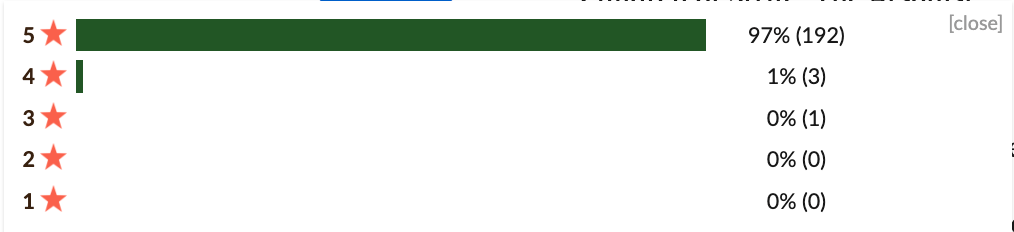
It is worth noting that Kirk practices what he preaches, as his public Goodreads ratings are 97% 5-star and 3% 4-star.
I understand why some authors prefer private feedback. Publishing a book is deeply personal, and public criticism hurts badly, especially in a space where many are building their careers from scratch.
This is, however, what being an author entails. Not to mention, reviews are for readers, not for the author. When a reader is trying to figure out how to spend their time and money, a nuanced 2 star review is a lot more helpful than a DNF.
You probably noticed in the bar graph above that Kirk has left one 3-star review on Goodreads, that being of author G.F. Allen’s novel A Kingsguard Tale: Road to Celestia in May of 2025. In his review, he offered critical feedback and said that the novel “struggles with information overload. The extensive lore and backstory, while fascinating, often arrive in lengthy info-dumps that disrupt the narrative flow.”
Something changed between May of last year and his back and forth with Goodwin, but it is impossible to say what. However, it is worth noting that just a few weeks prior to Goodwin’s tweet, Kirk himself faced a very critical public review of his work by a YouTube channel named “Menage a Typo.”
Menage a Typo
On April 8th, Menage a Typo posted a video review of Tyler Kirk’s novel Children of Strife: The Arsonist. The review was a two hour and fifteen minute discussion of the work, in which the reviewers called it “Dark Fantasy For A 12-Year-Old.”
The review was largely criticized, with some calling it “mockery” and “beyond just a critical review.” Author’s took exception to the thumnail (pictured below), which took Kirk’s cover and drew red x’s over the lead characters eyes and a tongue sticking out.
This was not the first time that Menage a Typo was criticized for their over-the-top thumbnails. A few weeks earlier, they reviewed Jan Miklaszewicz’s novel Eyes Wide Open and created a thumbnail of a knife stabbing the book with blood all around it, which many on X found distasteful.
It’s hard to draw a line between where honest critique ends and clout-chasing mockery begins. I advocated for Menage a Typo’s right to criticize novels they find poorly written. However, their thumbnails of blood, gore, and tongues sticking out closely approaches the line of disrespect, if not crosses it.
It is worth mentioning that nobody was better about the review of The Arsonist than Kirk himself, who commented in jest that the reviewer should “do book 2 next” and never criticized them for their review or thumbnail, as far as I could find.
Other authors in the space took exception, however, like author Brian Holshouser, who posted this tweet the following day.
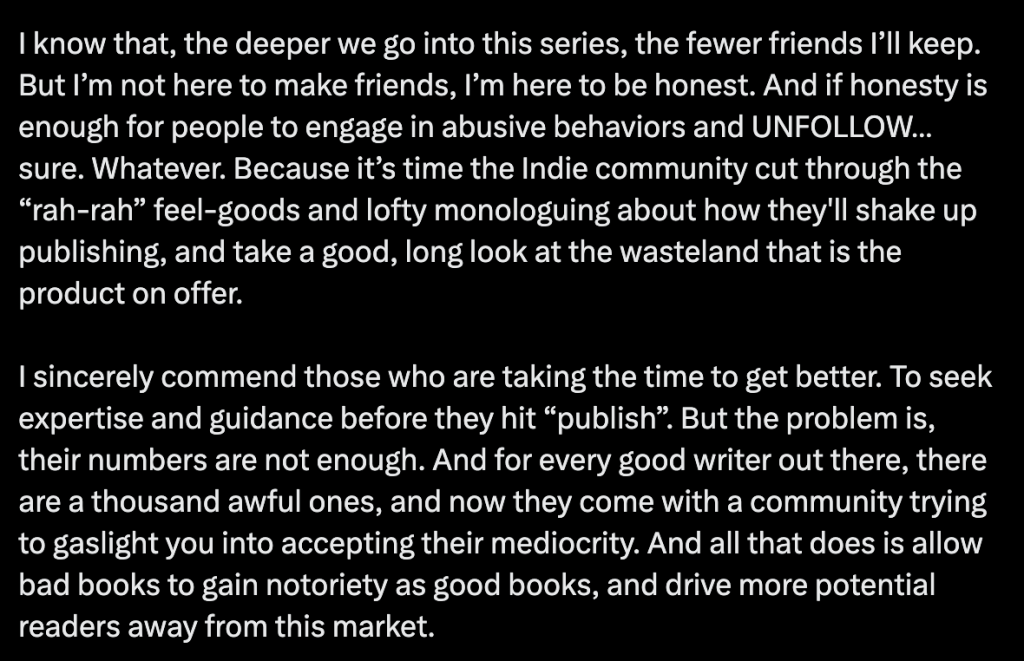
Menage a Typo has discussed their review series and the backlash it would most likely bring from the indie author community in a post that I could no longer find. They did not address the thumbnails, but did acknowledge that criticizing indie books will cause them to lose friends, and that readers are being driven away from the indie market when bad books “gain notoriety as good books.”
By the time J..M. Goodwin posted about reviews, the Menage a Typo video review of Kirk’s novel had been live for two weeks.
Back and Forth
After their discussion, Kirk and Goodwin emerged as the two figure heads on each side of the argument for or against public facing critical reviews. Goodwin, representing critique, and Kirk, representing talking to the author directly.
This evolved, however, as Kirk’s side began more to represent when he referred to as “Toxic Positivity”, a sort of meta-way of claiming that everyone reads differently and that readers are entitled to leave any review they choose, positive or not.
Over time, the back and forth between Goodwin and Kirk quickly turned into just a “forth”.
In the days following their original discussion, Kirk used or replied to “@jmgwritten” too many times to count or include in this article. He changed his profile picture in a mocking-attempt to “be more like him” and filmed a sarcastic video denouncing his old ways and choosing to read The Bible and write more “life-changing” fiction.
Many of these replies or responses were not on Goodwin’s tweets, but on others who were either commenting on the review drama or not. Some of those tweets are below:
It is worth noting that J.M. Goodwin has not responded or mentioned the username @TAR_Kirk since their original conversation on April 23rd, at least from what I can see, though as of this morning (April 29th), he is still tweeting about the subject.
A Critical Review
As a literature major and English teacher, I read books through a lens of author’s craft. It is my passion, it’s what I teach my students, and it is why I read. I treat all books this way, most notably a 2 star review of the Goodreads Choice Award for 2024, Martyr! by Kaveh Ahkbar, a book a lot of people love that I thought was really, really bad.
I saw this culture of resistance firsthand when I posted my review of indie novel Dark Bloom by Molly Macabre. It’s a book I was interested in checking out due to the love many in the indie community have of it, with many claiming it is the premier indie novel to read.
However, I found fault within Macabre’s novel, notably in the character depth and tonal inconsistency (remember those words). I published my review on April 21st, two days before the back and forth between Goodwin and Kirk.
I tried my hardest to express my thoughts in a way that was legitimate, nuanced, and didn’t come off as a personal attack to Macabre. I quoted and cited the passages I found fault with, taken from a notes page that I kept while going through the book. I aimed to be clear and constructive above all things.
I moved onto my next book and thought little of it afterwards.
The day after the Goodwin and Kirk argument, I posted a perspective on my X account. I didn’t @ either of the authors, nor reply to their posts, but in a time where it felt like nobody was taking the side of critical reviews, I thought I’d share my thoughts.
A short time later, Macabre was in the comments and called my energy “weird.”
Many authors commented things like “Preach!” underneath Macabre’s reply. It was seen by 1.4K people.
Full transparency: I don’t think I phrased my original tweet well. I don’t do well in short bursts. I should not have spoken in absolutes and my thesis was NOT that spending more time on a novel makes it unequivocally better.
Goodwin reposted my tweet, even though he misinterpreted what I was really trying to say.
The purpose of my tweet was not to criticize authors for not trying hard enough. My point was that not all novels are created equal. Some novels take a decade to craft and edit, and others are written in 5 months. Time alone doesn’t determine quality, but strong editing, revision, and craft almost always show in the final product. That usually takes time.
My point: Not all books deserve to carry a 4.5+ star rating on Goodreads. Not all books are created equal.
A short time later, Macabre replied to one of Kirk’s posts and referenced readers not being “kind.” In her response, she stated two very familiar criticisms one can make of novels that I recognized immediately as the language I used in my review of Dark Bloom.
What Macabre, Kirk, and others don’t understand, is that analyzing author’s craft in the nuances of storytelling are what I enjoy! That’s why I read! I don’t just look at a book and see zombies, or magic, and enjoy it automatically. I read books to see the secrets, the hidden symbolism, the characters feeling real and alive on the page. That’s my jam!
“Everyone reads differently,” as they say.
A few months ago, on February 5th of this year, I reached out to Macabre via DM. I asked her for advice, congratulated her for all her success, and told her how impressed I was by her marketing and her ability to get people to read and review her books. We had a really nice conversation and I thanked her for the advice she gave me.
But here we are, just two months later, and because I analyzed the craft of her novel, I’m not kind. And like Brian Holhouser said, if you do that, don’t expect to find support.
That’s the culture we’ve built in parts of the indie space.
An Inflated Market
Right now, the indie author market is flooded with 4.5+ star books. Some of these works are amazing, but unfortunately, that can’t be true for all of them. What is true is that these books are not being rated as if they were traditionally published books, because of three main reasons:
- Authors privatize their feedback of other authors.
- Readers are afraid to say how they really feel because they don’t want to face backlash.
- Readers are reviewing their friends books favorably because of their relationships with them.
I went onto Goodreads and looked at the ratings for some of the most beautiful books to ever be written. They were Anna Karenina, The Great Gatsby, One Hundred Years of Solitude, Middlemarch, The Brothers Karamazov, Don Quixote, East of Eden, and Moby-Dick.
These books, on Goodreads, have an average of 4.06 stars.
Then, I chose popular indie titles, of which I won’t name here. However, if you think a title would be on the list, it probably was. I chose 8, the same number as the classics above, and looked at their Goodreads ratings.
The indies, on average, were rated 4.47 stars.
“Everyone reads differently” is most definitely true, but these numbers speak for themselves. And when everything is rated highly, it becomes harder to figure out which novels in the indie space actually deserve the praise.
Why Should I Care?
My novel, Medusa; Or, Men Entombed in Winter has a 4.51 rating across 21 ratings on Goodreads. The problem is, reviews no longer function as a marketing tool. I can’t tell people they should read my novel because it’s rated highly, because all indie books are highly rated. If a random person wants to pick up an indie book, my novel is just one of a thousand.
How do great books stand out in this kind of market?
For me, I feel strongly that, even if readers were to be more critical of my novel, it would still have a high rating due to the quality of the character work, the storytelling, the pacing, and the intricacies embedded throughout. I would be delighted if someone wrote a review of my novel with the amount of insight, depth, and evidence my review of Dark Bloom had.
However, if you gave all authors truth serum, I don’t think everyone would feel this way about their books.
I certainly don’t want to become public enemy number one, but I don’t think silence on the subject is the answer, either. If indie authors only support each other when the feedback is positive, then what we’ve built is nothing more than an echo chamber.
I’d rather be part of a space where honest criticism exists, even when it’s uncomfortable, because that’s the only way great books rise above the noise.
If you’re looking for your next read, MEDUSA; OR MEN ENTOMBED IN WINTER is live on Amazon. I’d love for you to check it out. You can read it and rip it apart if you’d liked. I won’t be mad at you.
Love you guys.
-KF
EDITOR’S NOTE: Tyler Kirk commented on my article post about how I should include some quotes from the tweet below, in which he clarifies his stance. I did not see this post when I wrote the article and it should have been included.
Kirk mentions that “If you don’t like a book, leave 1, 2, or 3 stars—whatever you want to do. If someone else reads that book and gives it 5 stars, then oh well. Why do you care? It just makes you look envious and miserable…Then sell your book, stay in your lane, and do your thing. Do not be concerned about the works and opinions of others.”
I hope that this article clarified, at least a tiny bit, why other authors care. But you should give his post a read.


Leave a Reply